Veya Homes: Creating Sustainable Quality Homes with Grown in Britain.
Veya Homes put quality and excellence at the heart of their building practices.
But what happens when a construction company also asks themselves the tough sustainability questions, or when they commit to using locally sourced timber and make using sustainable resources their mission?
Like many in the industry, you may have wondered, where do we start on this topic and what expertise can we draw from?
It can be useful to hear from others who have already laid the foundations. How did they approach it, what challenges did they overcome and, crucially, what was the commercial and environmental impact?
We spoke to Sarah Harvey, Director, at Veya Homes about their experience of partnering with Grown in Britain to put sustainability at the heart of construction and modern living…
___________________________________
Veya Homes – ‘Modern living with sustainability at its heart.’
We are proud of our history and journey. Veya Homes was born out of a longstanding shop fitting and joinery company in Bristol. We were expert craftspeople first, with a commitment to exceptional construction practices and quality.
Working with wood builds an affinity and appreciation for the materials which make our business, and an awareness of the environmental impact of it. So, you could say we’ve always had sustainability at our core
Over time, our vision expanded. We wanted to use the knowledge and skills of our team to develop a high-quality modular building system. It needed to be sustainable in terms of the materials used, and the future energy consumption of the buildings themselves.
A high bar was set, and we had to ask ourselves tough questions:
- Can we place sustainability at the heart of what we do?
- Can homegrown timber supply chains deliver?
- Can sustainability be built in alongside commercial success?
- Can we measure success?
Vision, conviction, and drive were needed to find answers. But those in the construction industry will know, these are never in short supply. From here, our ethos was established…
‘Modern living with sustainability at its heart. Keeping sustainability in mind at every step as we build comfortable, quality homes to be proud of.’
Commercial and environmental objectives
Our commercial objective was to build sustainable homes which would not cost the earth to build or maintain.
We would move away from traditional concrete block and brick and would make it our mission to use sustainable materials, sourced as locally as possible. We wanted to demonstrate to the housing market environmental objectives can be achieved as part of the standard house-building model. We are doing this.
A recent analysis of three completed build projects showed 91% of timber used was from non-UK sources – offering huge potential for change.
AES Sustainability Consultants were appointed to undertake an Embodied Carbon assessment referring to two detached and two semi-detached domestic homes. The design included a timber façade with profiled steel sheet roof cladding and engineered hardwood flooring.
The report aimed to identify carbon emission hotspots and opportunities to reduce the environmental impacts of construction projects.
Finding our partner: Grown in Britain
To achieve our goals, we needed to work in partnership. Sustainability goals are a collective aim – they can’t be achieved alone. The feeling of being ‘on your own’ or not knowing where to start represents a barrier to all of this.
‘Finding an expert partner was key.’
We leaned heavily on the expertise established at Grown in Britain, who are leading the way in driving best-practice sourcing of wood and timber and provide a Grown in Britain certification scheme for locally sourced ‘good wood,’ meaning we could build with the peace of mind we were fully aligned with our sustainability goals. Finding an expert partner was key.
But it had to work logistically. Sustainability must dovetail with build quality, timelines, supply chains and costs. This was the big question we knew we would need to answer and keep coming back to. Darren Sims, our Senior Contract Manager, won’t compromise on quality and he can’t speak highly enough of the timber we worked with.
‘The timber was delivered to our joinery workshop, where, in turn, we
manufactured all the SIP panels ourselves. Feedback from our joinery manager
was the timber was the best he has worked with for a long time due to the
straightness of each length and the lack of knots.’
Darren Sims MCIOB, Senior Contracts Manager
The Grown in Britain Project Standard with Veya Homes was, therefore, designed to measure the use of home-grown timber and timber products and award recognition by certifying the defined timber element as being grown in the United Kingdom.
Barriers and challenges
No build is without challenge. As a result, those in the construction industry are uniquely able to balance vision, pragmatism, and optimism. Firstly, we built the houses during the Covid-19 pandemic. So, access to materials, labour, lead times and planning were all issues for us. Availability of materials was a major challenge, even when most were sourced in the UK! However, let’s face it, the locality of our timber allowed us to work through this more easily than most.
Secondly, we expected the houses would attract a particular type of customer… someone who was proud to live in a sustainable house. We have interestingly realised this is not the case, most of our customers enjoy the sustainability factor as a bonus rather than one of the key criteria when looking for a new home.
‘The great thing is there is more to come.’
The requirement and call for net zero carbon emissions is only getting stronger. Alongside this, the next generation of home buyers will be more environmentally conscious than ever. We have, therefore, future-proofed our commercial and environmental offer. The wonderful thing is there is more to come.
The homes we have built look stunning and have such an excellent finish they were valued considerably higher than we were anticipating. The thermally modified Brimstone ash from Vastern Timber on the external façade is just so incredibly beautiful and we’re delighted to have incorporated GiB certified BSW timber via Travis Perkins.
We are excited to have set a blueprint for our future work. We are also confident we have laid a path for other construction companies to follow. Change requires people to take the first steps. With the help of Grown in Britain, we are proud of our role in this.
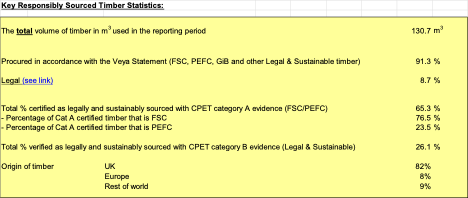
82% of the Veya house build met Grown in Britain project requirements, demonstrating just how much home-grown timber could be used given the opportunity, and the project found a mere 6% of materials required a design change to accommodate UK supply, underscoring the compatibility of our sustainable practices with standard market values.

Environmental Impact
We worked with Grown in Britain to assess the impact of the build from ‘cradle to practical completion.’ Whilst we were delighted with the construction, quality, and aesthetics, had we also met our environmental objectives?
The Embodied Carbon Assessment Report has highlighted the next steps to reducing CO2 emissions will be to explore the use of recycled timber in our supply chain and retrofit and upgrading work. We look forward to partnering with Grown in Britain on this.
AES Sustainability Consultants Limited carried out the assessment with the impact of the timber ground and front elevations, external and internal timber stud walls, timber window frames and timber façade having a significant impact.
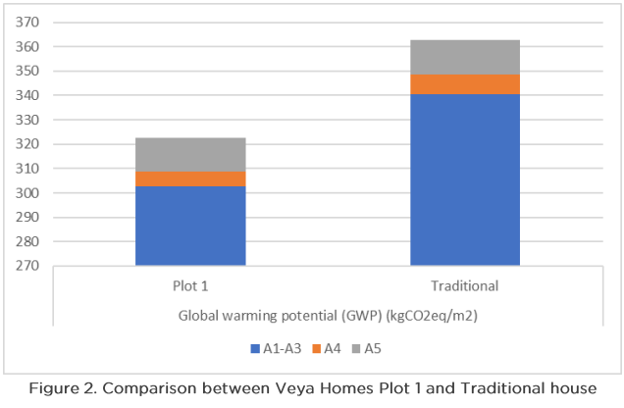
A direct comparison to a traditional block and brick build showed pleasing progress. The product phase (A1 – A3) contributes more than 90% of the overall total CO2 kg equivalent. It is here the biggest reduction in Global Warming Potential can be made.
The methodology used One Click LCA and the assessment method followed BS 15978:2011. Lifecycle assessment was for A1-A5, so from source to completion of the build.
Plot 1 was a detached property and the following chart shows the Veya Homes build to have a significantly lower carbon embodied carbon than a traditional build, particularly in the A1-A3 product stage.
And we did it!
Our builds, with the continued input from Grown in Britain, produced significantly lower embodied carbon during raw material supply, transport and manufacturing. This was supported by lower transport-related emissions in phase A4, largely linked to the local sourcing of timber.
Our footprint was lessened. Our impact was greater.
Advice and comment for our colleagues in construction
Building sustainably is within reach. Put simply, you can do it!
- Using homegrown timber and materials works; the quality and commerciality are there and the supply chains exist
- Aligning commercial and environmental objectives is achievable.
- Changing build practice from traditional to majority wood construction is viable.
- Use the expertise of organisations like Grown in Britain.
Our advice would be to do your research and speak to the experts.
————————————–
Using GiB-certified supply chains means you can be 100% satisfied the materials you are using are grown in this country and in a sustainable way.
Go for it! Right now, commercial and environmental arguments are working together to present new opportunities.
Read the full project report from AES Sustainability Consultants here.